Wednesday, February 10, 2010

Matt. 24 -- let no man deceive you

Israel had, without quite realizing it, missed the last exit ramp and was hurtling down the road towards the missing bridge. Bad times were ahead, as Jesus spells out in this chapter. He gives His disciples the specific signal they'll need to heed, if they are to jump clear of the wreck:
Mat 24:33 Aynı şekilde, bütün bunların gerçekleştiğini gördüğünüzde bilin ki, İnsanoğlu yakındır, kapıdadır.
A consistent metaphor used in the Bible is "clouds," as indicators of God's judicial presence. In other words, they tell us, "Here comes the judge."[1] When the pieces fell into place, it was time to make a hasty exit.

Meanwhile, if they valued their temporal and eternal welfare, there was a more immediate threat they had to watch out for: false prophets.
Mat 24:4 İsa onlara şu karşılığı verdi: "Sakın kimse sizi saptırmasın!
Mat 24:5 Birçokları, 'Mesih benim' diyerek benim adımla gelip birçok kişiyi aldatacaklar.
...
Mat 24:11 Birçok sahte peygamber türeyecek ve bunlar birçok kişiyi saptıracak.
Hegel said, "The owl of Minerva only flies at twilight." Only towards the end of a civilization, he thus asserted, do its inhabitants achieve wisdom. Jesus took a blunter, and more realistic, view:
Mat 24:28 "Leş neredeyse, akbabalar oraya üşüşecek.
Bad times bring forth worse people. Adolph Hitler leads his people out of economic desperation and into prosperity, and then on towards a shining destiny. FDR saves American capitalism by hog-tying American businesses and saddling a nation with a massive layer of socialist bureaucracies. A glib-tongued Kenyan who has achieved nothing but speaks in the White dialect of American English and can read a teleprompter offers salvation to a worried, nation, "Hope" and "Change." He will command the seas to stop rising, after all.

______________

[1] For fans younger than their mid-fifties, this is a famous line from the comedy variety show Rowan and Marti's Laugh-in.

Tuesday, February 9, 2010

Matt. 23 -- beware The Man

The resentment-driven underclass in America esteems a practice they call "sticking it to The Man." The Man is the personification of the social structure they blame for their woes.[1]

Jesus had a better idea -- outperform The Man. Self-governing people, people who honor the Lord as their king, live better lives than slaves.[2] This chapter is a withering indictment of the ruling class of first century Israel. Like the Mayor played by Bill Murray in the excellent little movie City of Ember, these people were willing to see their society collapse, as long as their own nests were feathered.[3] Let's look at a few extracts from this chapter:
Mat 23:1,2 Bundan sonra İsa halka ve öğrencilerine şöyle seslendi: "Din bilginleri ve Ferisiler Musa'nın kürsüsünde otururlar.
Mat 23:3 Bu nedenle size söylediklerinin tümünü yapın ve yerine getirin, ama onların yaptıklarını yapmayın. Çünkü söyledikleri şeyleri kendileri yapmazlar.
These folks are in power. To stay out of trouble, take them at their word and live up to the values they assert. Socialists claim to care for "the poor." So, our lives should be characterized by true benevolence, true charity. However, this concern of their rarely, if ever, translates into practical, sacrificial action on their parts.

The ruling class is where it is, so we need to be aware of them. However, we do not need to take them as seriously as they take themselves. Rush Limbaugh became an overnight success after 17 years, by simply pointing out the discrepancies between what the ruling class said, and what they actually did. The "filling" in this sandwich chapter is withering scorn poured upon the heads of the ruling elite and its media outlets. Injunctions for His disciples to do better. As Kingdom people, as self-governing people, we should not be driven by the power lust that characterizes contemptible rulers.

Let's drop down to verse 37 to see the bottom line, wherein Jesus compares Himself to a chicken:
Mat 23:37 "Ey Yeruşalim! Peygamberleri öldüren, kendisine gönderilenleri taşlayan Yeruşalim! Tavuğun civcivlerini kanatları altına topladığı gibi ben de kaç kez senin çocuklarını toplamak istedim, ama siz istemediniz.
Mat 23:38 Bakın, eviniz ıssız bırakılacak!
Mat 23:39 Size şunu söyleyeyim: 'Rab'bin adıyla gelene övgüler olsun!' diyeceğiniz zamana dek beni bir daha görmeyeceksiniz."
The bridge is out. Israel has just driven past the last exit ramp.

_________
[1] This sense of entitlement leads to numerous acts of pillage and pilferage. For examine, Social Security Supplemental funds are paid out to handicapped folks, or the parents of handicapped children. SO, coach the kids to act crazy, and the government will send you another check in the mail. The raids on the nation's productive class are sanctioned by the politicians whose role in this danse macabre is to buy the votes of the underclass with "public" money.

[2] The Finno-Russian War of 1939 quantified this observation. The Finns were outnumbered by around 12 to 1 -- but their soldiers were free men protecting their homes. The Russian invaders were conscripts.

[3] At the end of the Ottoman Empire, the ruling class in Istanbul were willing to sign away a whole nation to foreign masters, in exchange for their own continuing roles as pampered puppet rulers.

Sunday, February 7, 2010

Matt. 22 -- the badly-dressed man

This chapter has a lot going on in it. For example, Matthew, the former tax collector, has yet another story on taxes (see also Matt. 17:21). The enemies of Jesus try again to outwit him, and are handily routed, publicly humiliated.

People of a certain age remember a bumper sticker prevalent during the Vietnam era -- "Suppose they gave a war and nobody came?" This recalls the parable that launches this chapter. The Kingdom of Heaven is like an incredible feast, a party. Strangely enough, the people honored by the first invitation (the Jews) not only snubbed the host, but mistreated the delivery boys. The King did not take this calmly -- and his verdict on first-century Israel was devastating:
Sonra kölelerine şöyle dedi: 'Düğün şöleni hazır, ama çağırdıklarım buna layık değilmiş.
Then / to his slaves / this saying / he said: 'The wedding / feast / is ready, / but / those who were invited / to it / worthy / were not.

It's not safe to snub the King's summons. Even when, especially when, He has invited you to a joyous and exuberant feast.

It's also not safe to try to get in on the gravy train when wearing the colors of a rival gang:[1]
Mat 22:11 "Kral konukları görmeye geldiğinde, orada düğün giysisi giymemiş bir adam gördü.
Mat 22:12 Ona, 'Arkadaş, düğün giysisi giymeden buraya nasıl girdin?' diye sorunca, adamın dili tutuldu.
Mat 22:13 "O zaman kral, uşaklarına, 'Şunun ellerini ayaklarını bağlayın, dışarıya, karanlığa atın!' dedi. 'Orada ağlayış ve diş gıcırtısı olacaktır.'
Mat 22:14 "Çünkü çağrılanlar çok, ama seçilenler azdır."
Modern bureaucrats hold meetings. The oriental potentates had feasts, formal occasions when the servants and subjects would report on conditions in their satrapies, and when the King would set the direction for the Kingdom's forthcoming activities. The King would furnish a rich table, and provide festive robes for the guests. In donning the robe, the guest accepted the King's authority. In feasting at the table, the guest was incorporated, metaphorically, into his body, to serve as his extensions throughout the realm.

It's communion Sunday, I need to get ready for church.
______________

[1] "Color riding" is the tradition of motorcycle gangs, each of which has its own "colors," its emblematic jacket.

Saturday, February 6, 2010

Matt. 21 -- the hungry man of faith

First-century Israel was a glittering, influential culture. Jerusalem was the Mecca of a world-spanning community of faith, a place of pilgrimage for Jews and proselytes. A non-stop work ethic and a passion for learning helped the Jews to prosper wherever they went. A reasonable faith in one God attracted interest wherever they went. All seemed to be well.

As this acted-out parable demonstrated, however, Jesus saw beyond the superficial to the rot at the heart of the culture:
Mat 21:18 İsa sabah erkenden kente dönerken acıkmıştı.
Mat 21:19 Yol kenarında gördüğü bir incir ağacına yaklaştı. Ağaçta yapraktan başka bir şey bulamayınca ağaca, "Artık sonsuza dek sende meyve yetişmesin!" dedi. İncir ağacı o anda kurudu.
Mat 21:20 Öğrenciler bunu görünce şaşkına döndüler. "İncir ağacı birdenbire nasıl kurudu?" diye sordular.
Mat 21:21 İsa onlara şu karşılığı verdi: "Size doğrusunu söyleyeyim, eğer imanınız olur da kuşku duymazsanız, yalnız incir ağacına olanı yapmakla kalmazsınız; şu dağa, 'Kalk, denize atıl' derseniz, dediğiniz olacaktır.
Mat 21:22 İmanla dua ederseniz, dilediğiniz her şeyi alırsınız."
The fig tree, a frequent emblem for Israel, had plenty of leaves, but was barren. Soon, God's verdict upon this condition would be made visible. Yet people of faith would prevail in the coming time of chaos.

Thursday, February 4, 2010

Matt. 20 -- the unfair man

Day laborers are near the bottom of the social order, just a step above beggars.[1] In many cities, illegal immigrants cluster on certain corners, waiting. People who need a few hours of unskilled labor drive by, select the likeliest candidates, and pay them in cash at the end of the day. If the employer is ruthless, and shorts them on their pay, they have no recourse. The story Jesus told in this chapter resonated with an audience that knew first-hand about ruthless employers who would do something capricious from time to time just to keep the hired help off-balance: insecure, apprehensive, docile.
Mat 20:1 "Göklerin Egemenliği, sabah erkenden bağında çalışacak işçi aramaya çıkan toprak sahibine benzer.
Mat 20:2 Adam, işçilerle günlüğü bir dinara anlaşıp onları bağına gönderdi.
Mat 20:3 "Saat* dokuza doğru tekrar dışarı çıktı, çarşı meydanında boş duran başka adamlar gördü.
Mat 20:4 Onlara, 'Siz de bağa gidip çalışın. Hakkınız neyse, veririm' dedi, onlar da bağa gittiler. "Öğleyin ve saat üçe doğru yine çıkıp aynı şeyi yaptı.
Mat 20:5 (SEE 20:4)
Mat 20:6 Saat beşe doğru çıkınca, orada duran başka işçiler gördü. Onlara, 'Neden bütün gün burada boş duruyorsunuz?' diye sordu.
Mat 20:7 "'Kimse bize iş vermedi ki' dediler. "Onlara, 'Siz de bağa gidin, çalışın' dedi.
Mat 20:8 "Akşam olunca, bağın sahibi kâhyasına, 'İşçileri çağır' dedi. 'Sonuncudan başlayarak ilkine kadar, hepsine ücretlerini ver.'
Mat 20:9 "Saat beşe doğru işe başlayanlar gelip kâhyadan birer dinar aldılar.
Mat 20:10 İlk başlayanlar gelince daha çok alacaklarını sandılar, ama onlara da birer dinar verildi.
Mat 20:11 Paralarını alınca bağ sahibine söylenmeye başladılar:
Mat 20:12 'En son çalışanlar yalnız bir saat çalıştı' dediler. 'Ama onları günün yükünü ve sıcağını çeken bizlerle bir tuttun!'
Mat 20:13 "Bağ sahibi onlardan birine şöyle karşılık verdi: 'Arkadaş, sana haksızlık etmiyorum ki! Seninle bir dinara anlaşmadık mı?
Mat 20:14 Hakkını al, git! Sana verdiğimi sonuncuya da vermek istiyorum.
Mat 20:15 Kendi paramla istediğimi yapmaya hakkım yok mu? Yoksa cömertliğimi kıskanıyor musun?'
Mat 20:16 "İşte böylece sonuncular birinci, birinciler de sonuncu olacak."
Oh, yes. The people knew about mean bosses. Many of those who heard Jesus with gladness came from the lower social orders, and had suffered this kind of abuse. The astonishing thing is, Jesus was talking about God as the capricious boss, and His Kingdom as the place where things do not turn out as expected.
____________

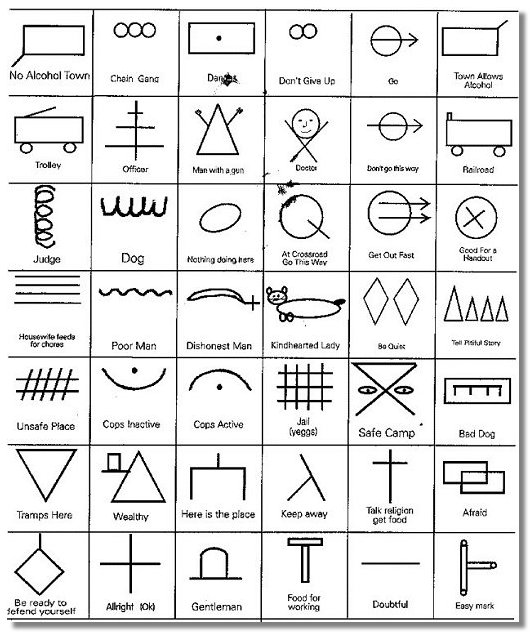
[1] A century ago, America had a vigorous "hobo" subculture. These restless souls "rode the rails," from place to place by secreting themselves in freight trains. They had their own idiom, including a set of "hobo signs," symbols inscribed on places where a man could get a sandwich in exchange for a few hours' work, places with a mean dog, or a mean cop. Hobos considered themselves to be migratory laborers, and looked down upon tramps (migratory non-laborers) and bums (non-migratory non-laborers).


Tuesday, February 2, 2010

Matt. 19 -- a man and a woman

Thingamatropic walking sticks begin as young sassafras saplings, entwined by a vine. Over the years, as the two plants grow up together, each alters the shape of the other. In God's economy, marriage also result in two dissimilar beings growing together, and bending each other into a new shape. Having one other person so close, so inside your perimeter, your comfort zone, makes you a different person. You have someone else to think about as you make your decisions. Someone else to help you think. A guy I knew, who struggles with Aspergers syndrome symptoms, prayed desperately for years for wisdom in the area of human relations. He came to see that his prayers had been answered, in the form of an incredibly insightful wife. Even as a blind man can get around with the help of a guide dog, this guy learned to see situations through his wife's eyes, thereby avoiding uncountable faux pas. He described the relationship as a dual-processor computer, with a 128-bit bus connecting the processors. As long as the bus is maintained, each processor can benefit from the data the other processes.

Let's look at the way Jesus describes the ideal situation:
Mat 19:3 İsa'nın yanına gelen bazı Ferisiler*, O'nu denemek amacıyla şunu sordular: "Bir adamın, herhangi bir nedenle karısını boşaması Kutsal Yasa'ya uygun mudur?"
Mat 19:4,5 İsa şu karşılığı verdi: "Kutsal Yazılar'ı okumadınız mı? Yaradan başlangıçtan 'İnsanları erkek ve dişi olarak yarattı' ve şöyle dedi: 'Bu nedenle adam annesini babasını bırakıp karısına bağlanacak, ikisi tek beden olacak.'
Mat 19:6 Şöyle ki, onlar artık iki değil, tek bedendir. O halde Tanrı'nın birleştirdiğini, insan ayırmasın."
C. S. Lewis discussed the differences between the Catholic and Protestant positions on divorce by starting with what the two faiths agree on: divorce is radical surgery, like a double amputation. The only disagreement is over whether or not the patient survives the operation.

Matt. 18 -- woe to the man

My daughter and her husband first began encountering one another at two contrasting locations: the campus Calvinist club, and the Society for Creative Anachronism (SCA). For some reason, a gauzy, fairy-tale sentiment lingers around the memories of the pre-Renaissance European culture. Young people try to recapture the sense of magic by dressing up in period costumes, affecting archaisms in their language, and fighting one another. Guys dress up in home-made plate steel armor, and bang away at each other with fiberglass swords, to the applause of spectators. Jugglers and acrobats perform, while musicians play lutes and flutes, and artisans create handicrafts.

Somehow, these people are drawn in by the external trappings of that which made the era noble, while overlooking the soul of chivalry: the solicitous care of the strong for the weak, the noblesse oblige[1] that matched matched power with duty. Again, these beautiful young people rarely give credit to the Christian faith that inspired small cities, of a few hundred thousand souls, to spend several generations building the incredible cathedrals of Europe. The faith that led to a decentralized, but continent-spanning, civilization.

The Christian message teaches that God cares for those who are unable to care for themselves: the widow, the orphan, the handicapped -- and those who are wise share this concern. This is a message with teeth it, though. Enforced with harsh language:
Mat 18:1 Bu sırada öğrencileri İsa'ya yaklaşıp, "Göklerin Egemenliği'nde en büyük kimdir?" diye sordular.
Mat 18:2 İsa, yanına küçük bir çocuk çağırdı, onu orta yere dikip şöyle dedi: "Size doğrusunu söyleyeyim, yolunuzdan dönüp küçük çocuklar gibi olmazsanız, Göklerin Egemenliği'ne asla giremezsiniz.
Mat 18:3 (SEE 18:2)
Mat 18:4 Kim bu çocuk gibi alçakgönüllü olursa, Göklerin Egemenliği'nde en büyük odur.
Mat 18:5 Böyle bir çocuğu benim adım uğruna kabul eden, beni kabul etmiş olur.
Mat 18:6 "Ama kim bana iman eden bu küçüklerden birini günaha düşürürse, boynuna kocaman bir değirmen taşı asılıp denizin dibine atılması kendisi için daha iyi olur.
Mat 18:7 İnsanı günaha düşüren tuzaklardan ötürü vay dünyanın haline! Böyle tuzakların olması kaçınılmazdır. Ama bu tuzaklara aracılık eden kişinin vay haline!
In Afghanistan, a popular proverb asserts that "a woman is for procreation, a boy is for pleasure." In America, if you merely have pictures of that transaction on your computer, you can find yourself in jail for years -- stripped of profession, status, property, liberty. Common law remembers is roots from time to time.
______________

[1] a Latin phrase meaning "nobility obligates." High rank imposes high responsiblities.